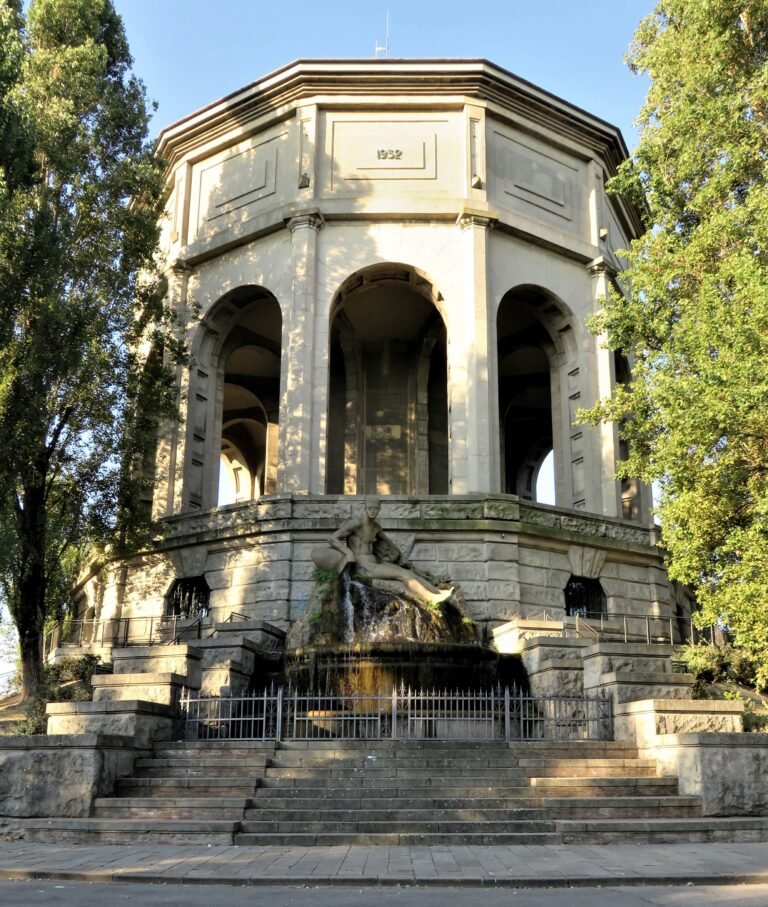
EUR is the strangest quarter of Rome: a monumental city centre with no old city around it, drawn from scratch at the end of the 1930s for an event that never took place. The Esposizione Universale di Roma, planned for 1942 under a master plan directed by Marcello Piacentini, was cancelled as the war closed in, and its half-built pavilions stood empty for a decade before Rome grew around them. Three buildings tell the story of the quarter better than any plan, and they sit within a short walk of one another. All three are collected in the curated route EUR (E42) Rationalist Walk, and each has its full entry in the archive.
The building that ran the exposition
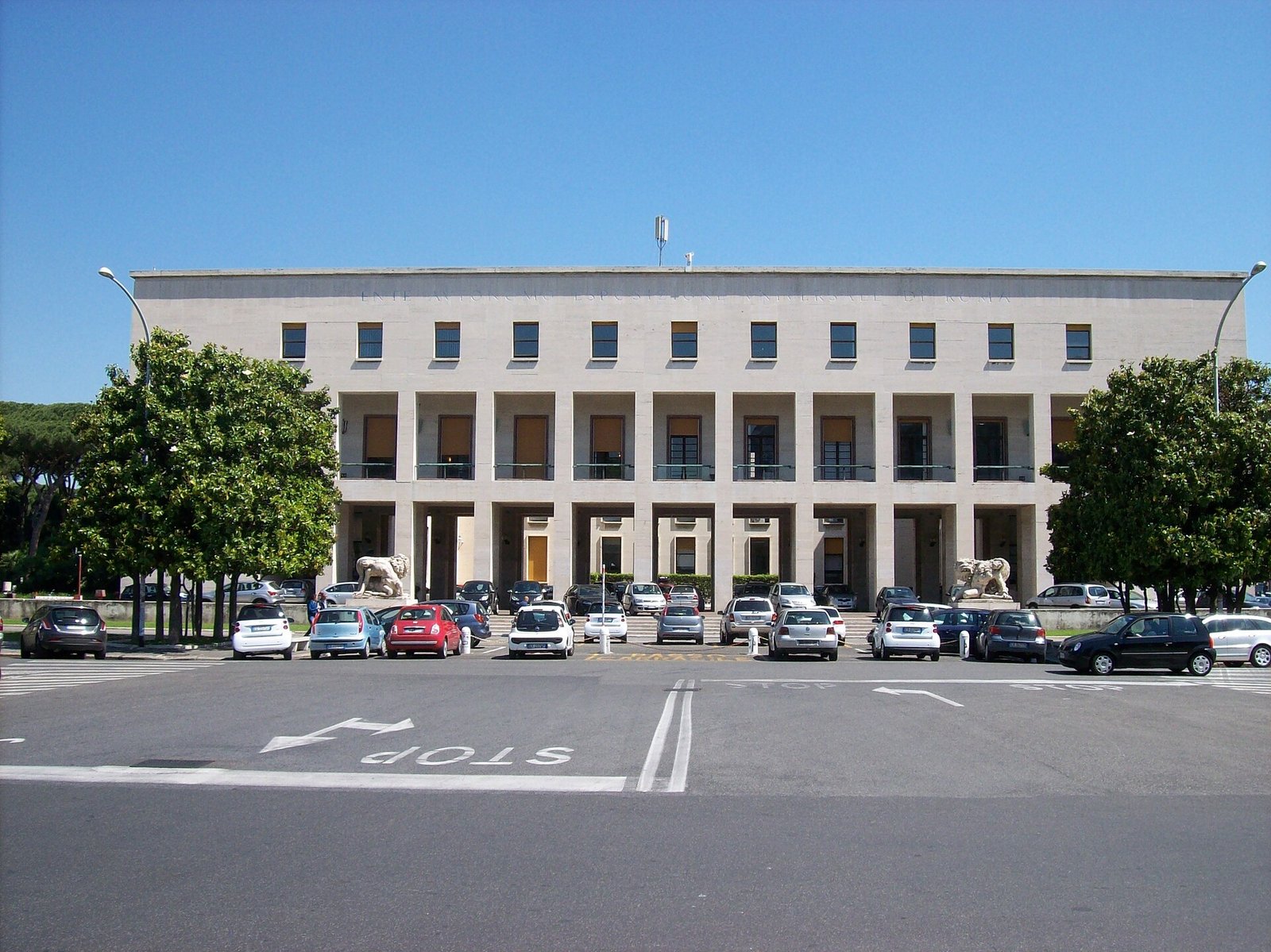
The walk starts where EUR itself started. The Palazzo degli Uffici was the working headquarters of the Ente Autonomo, the agency created to run the exposition, and it was the first permanent building of the quarter: Gaetano Minnucci won the commission on 25 October 1937, ground was broken that December, and the offices were occupied by 1939. It is stripped classicism at its most functional, and it carries one of the quarter’s densest documents — Publio Morbiducci’s travertine bas-relief The History of Rome Through Building Works, unveiled over the main entrance in 1939.
The square Colosseum
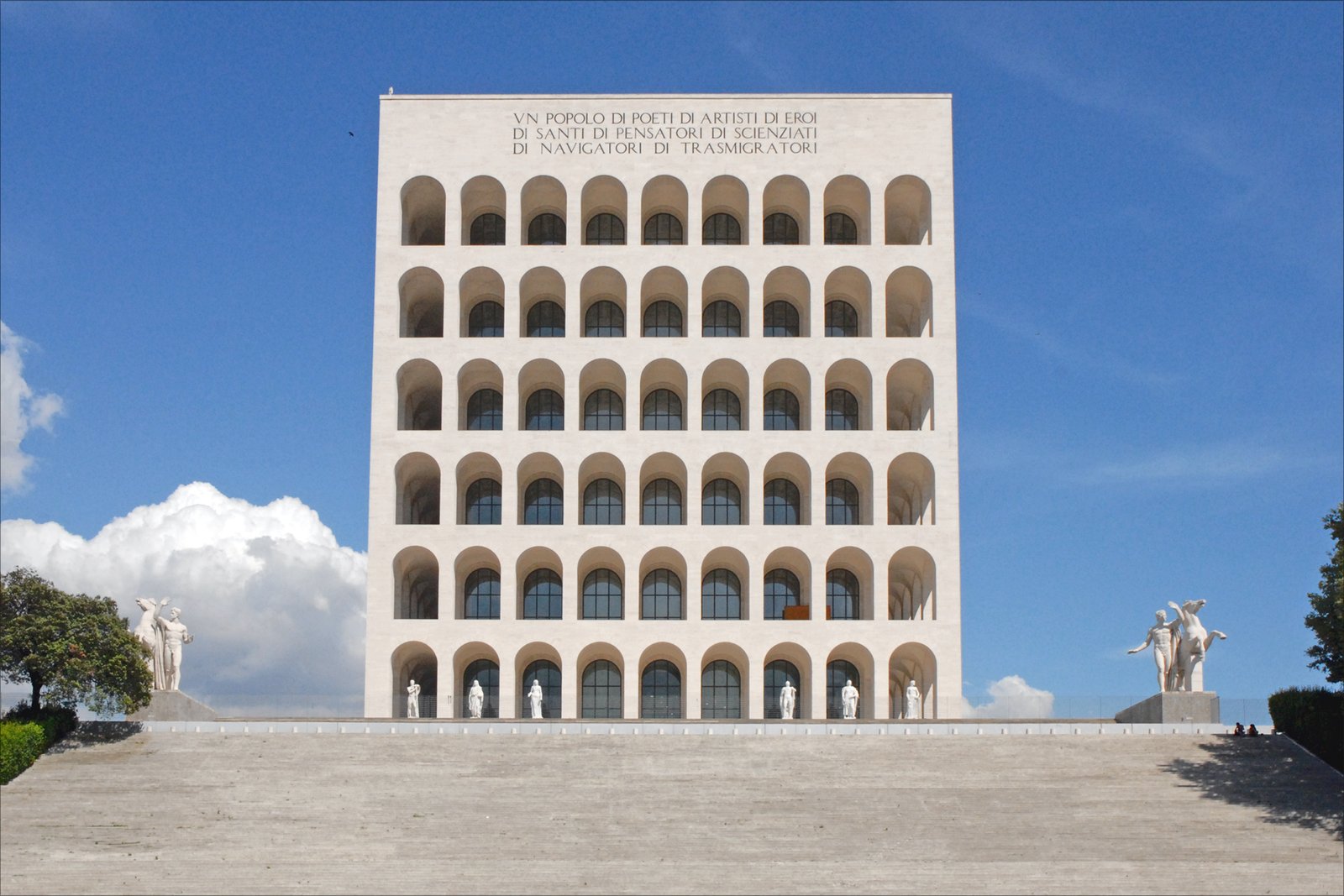
A few minutes away rises the building Romans long ago renamed. The Palazzo della Civiltà Italiana (Giovanni Guerrini, Ernesto La Padula and Mario Romano, 1938–1943) is a travertine cube of stacked arches — six rows of nine per face — lifted on a plinth above the quarter’s southern edge. The Colosseo Quadrato was finished in wartime for an exposition already cancelled, and for decades it had no settled use at all. Since 2015 it has been the headquarters of the fashion house Fendi, and its lit arcades have become the emblem of the whole district.
Libera’s cube of light
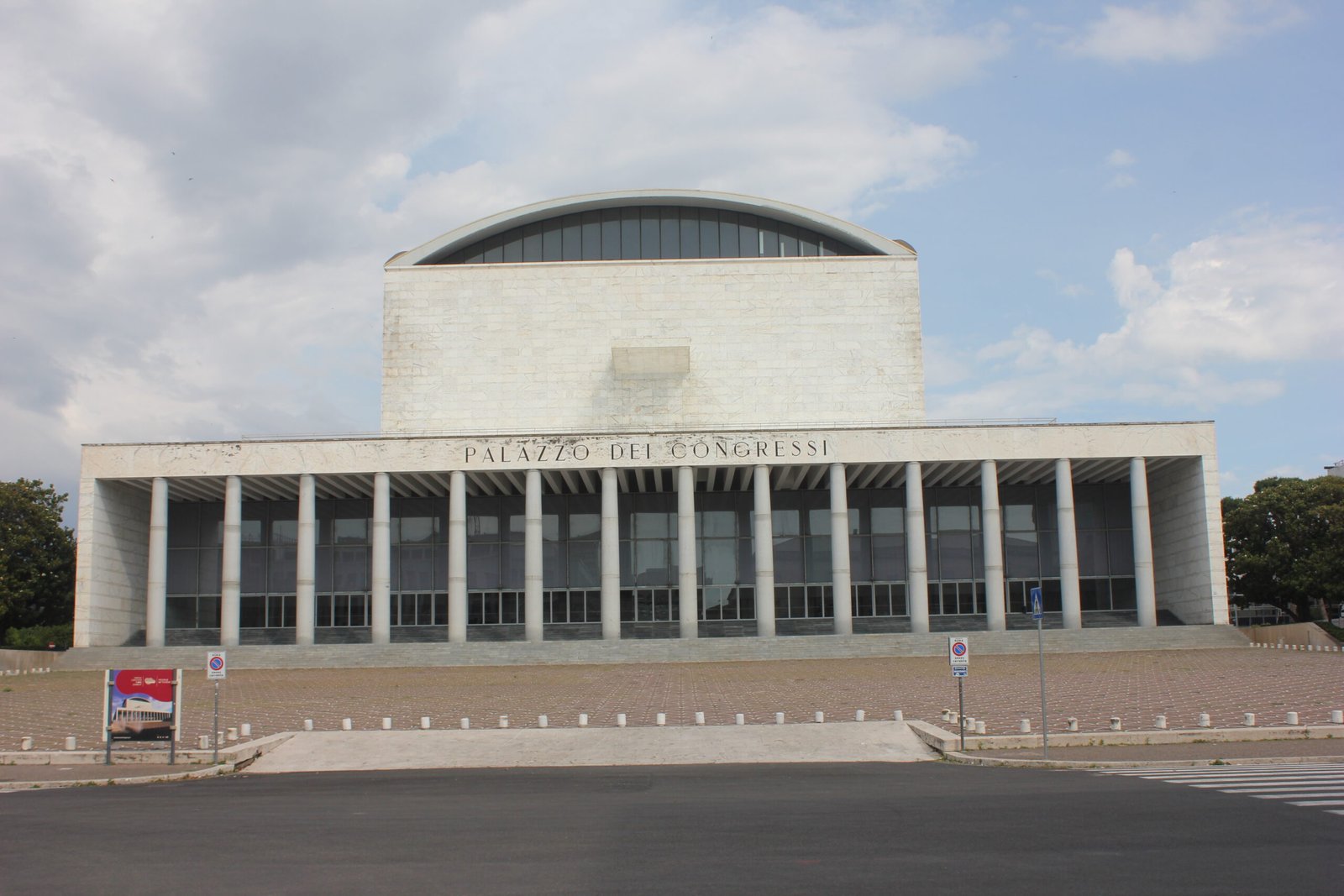
The third stop took the longest to arrive. Adalberto Libera won the 1937 competition for the Palazzo dei Congressi with a design of radical clarity: a 45-metre travertine cube wrapped around a single luminous hall, spanned by thirteen reinforced-concrete frames of 28 metres each and closed at the rear by a glazed wall 65 metres wide. Begun in 1938, interrupted by the war, it was completed only in 1954 — by which point the building conceived for the regime’s exposition had become a congress hall for the republic. It remains one of the clearest statements of Italian rationalism at civic scale.
Walk it with the map
The three stops are collected in the curated itinerary EUR (E42) Rationalist Walk: an interactive map with the route, a play-through tour of the stops, and GPX and KML files to take along on your own navigator. Each stop links back to its full entry in the archive, with history, sources and practical notes.
Reading the quarter
EUR asks more of a visitor than its photogenic arcades suggest. It was conceived as the showcase of a regime, finished by a republic, and colonised over time by ministries, museums and corporate tenants; the propaganda reliefs and the inscriptions are still on the walls, part of the record. These pages document that heritage without celebration and without erasure: what was designed, by whom, what the war interrupted, and what each building has become. Read together with the founded towns of the Pontine plain, the quarter shows the same programme at metropolitan scale — and the walk is the way to read it.
On film, 1939
The E42 under construction survives on newsreel. Twice in 1939 the Istituto Luce filmed official visitors to the site, each guided by the commissioner general, Vittorio Cini.
On 2 August 1939 the Princess of Piedmont, Maria José, toured the works (Giornale Luce B1558):
On 18 October 1939 — some seven weeks into the war — Grover Whalen, president of the New York World’s Fair, inspected the site with Cini and went on to Ostia Antica (Giornale Luce B1602):
Source: Archivio Storico Luce, Giornale Luce B1558 (2 August 1939) and B1602 (18 October 1939) — archivioluce.com.